
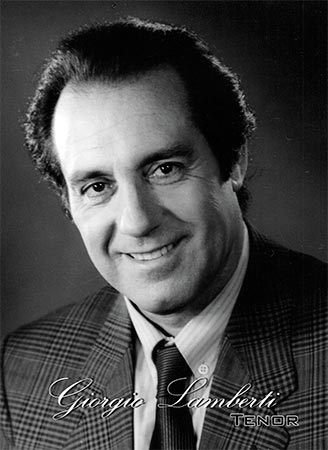

Born on July 9, 1938, in Adria, a small town in Veneto, Giorgio Lamberti, a world-renowned tenor, left his mark on the history of opera through his talent and perseverance.
A few months after his birth, his family moved to Bolzano. It was here that he spent his childhood, and discovered music by learning music theory at the age of eight. On the eve of his tenth birthday, he entered the Claudio Monteverdi Conservatory to study violin with Professor Giorgio Mendini, first violinist of the Arena di Verona Orchestra. However, he realized that the violin did not suit him, and turned his back on the instrument after five years of lessons.
With a keen interest in lyric art, and aware of his natural voice, he decided in 1957-1958, while studying to become an accountant at the Istituto Tecnico Commerciale, to return to the conservatory, this time to devote himself to opera singing.
In 1959, during his military service in Naples, he obtained an exemption that allowed him to continue his lessons at the Conservatorio di San Pietro a Majella. Four years later, he was awarded a scholarship to the prestigious La Fenice in Venice. This opportunity gave him the chance to work with various professors and, above all, to refine his repertoire alongside his classmates Silvano Carroli and Maria Chiara. He then perfected his training with Maestro Ettore Campogalliani, a figure renowned for his knowledge of the lyrical repertoire and bel canto, and who had trained illustrious singers such as Luciano Pavarotti and Mirella Freni.
His very first stage appearance took place in the early 1960s, in Catania, Sicily, in Lorenzo Perosi’s opera La Risurrezione di Cristo. His career truly took off in 1964, under his real name, Giorgio Casellato. He replaced tenor Gastone Limarilli, who was unavailable for the role of Arrigo in Verdi’s I Vespri Siciliani performance in Rome.
The second half of that decade was rich and intense for the young tenor, who took on prestigious roles such as Oedipus, Manrico, Radamès, Turridu and Calaf.
Tired of being considered the brother of Renzo Casellato, a light tenor with no family relationship, he decided to add his paternal grandmother’s name and became Giorgio Casellato-Lamberti. A few years later, he completely dropped the name Casellato to adopt Giorgio Lamberti, a name easier for English-speaking audiences to pronounce.
His career took a decisive turn in 1970. On the evening of a Carmen performance at the Arena di Verona, a dispute broke out between tenor Franco Corelli and the management. Corelli refused to sing and demanded that the performance be cancelled. The conductor Oliviero De Fabritiis then suggested that the artistic director call on Giorgio Lamberti as a last-minute replacement. Without any preparation, his performance was so perfect that the audience and critics were captivated.
Thanks to his impressive vocal range, from high D to low A, Giorgio Lamberti could interpret lyrical works requiring exceptional technical mastery. This gift allowed him to build a much more extensive repertoire than most tenors, with over 80 different operas to his credit. He played emblematic roles such as Cavaradossi, Chénier, Pinkerton, Riccardo and Johnson, but also less popular works like Fernando Cortez, L’Africaine, and Belfagor.
Giorgio Lamberti, a relentless perfectionist, approached each of his performances with remarkable intensity and passion. With his virile timbre and power, he is still considered today the ideal interpreter of the Italian romantic repertoire.
He ended his career in 1996, after a final performance of Camille Saint-Saëns’ Samson and Delilah, in the role of Samson, at the Opernhaus Zürich.

Discography

The Book

A Life at the Opera, The Tenor’s Archives
Discover the incredible experience of Giorgio Lamberti, a true opera legend whose voice has left an indelible mark on history. With over 35 years in his career and a repertoire of more than 80 operas, Lamberti has graced the world’s greatest stages, leaving behind an unparalleled vocal and artistic legacy. Dive into the life of an extraordinary tenor whose passion and talent have moved millions of spectators. This exceptional book is enriched by over 150 photographs from his personal archives, offering an intimate and unprecedented look at his career.
Written in French, English and Italian
- 128 p.
- 195 X 250 mm
- Digital printing
- Hardcover
- Publication July 2025
- ISBN: 978-2-9601764-6-9
- 34,00 €


